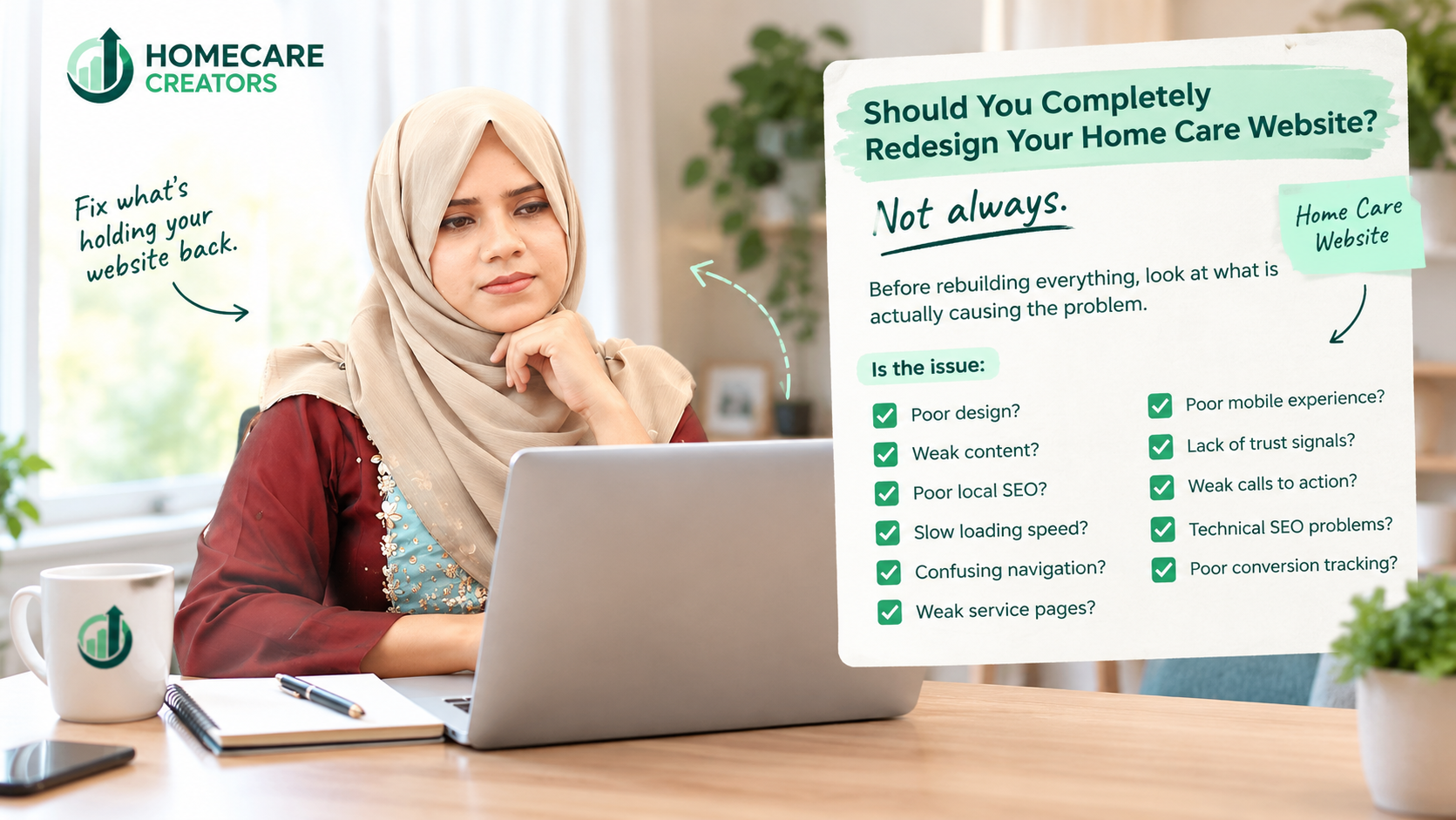
Most home care websites fail to convert families — not because of poor design, but because they're built around the agency instead of the family's psychology. Here are the 11 elements your site needs to turn visitors into consultations.
Why Most Home Care Websites Fail to Convert Families
Most home care agency websites were built to check a box. The owner needed "a website," hired someone on Fiverr or used a template, uploaded some stock photos of seniors holding hands, listed their services, put their phone number somewhere, and called it done.
That website isn't hurting you. But it's not helping you either. In a market where families are making a high-emotion, high-stakes decision about the care of someone they love, a mediocre website is the equivalent of showing up to a first meeting in a wrinkled shirt — technically acceptable, but not what wins the business.
A home care website that actually converts families into clients is a fundamentally different type of asset. It's built around the family's psychology — their fears, their questions, their decision criteria — and it guides them from "I need help" to "I'm calling this agency" in under 60 seconds.
Here are the 11 elements that separate a home care website that generates leads from one that just sits there.
1. A Crystal-Clear Value Proposition Above the Fold
"Above the fold" means what a visitor sees before they scroll. On a home care website, this is the most valuable real estate you have — and most agencies waste it on generic headlines like "Compassionate Care for Your Loved Ones" that say nothing and differentiate you from nobody.
Your value proposition above the fold should answer three questions in under 10 words: What do you do? Who do you do it for? Why should I choose you?
Examples that work:
- "Licensed Home Care for Seniors in Miami — Background-Checked Caregivers, 24/7 Support"
- "Dementia-Specialized In-Home Care in Tampa | Your Loved One Stays Home, Safely"
- "Private Duty Home Care in Boca Raton — 100+ Five-Star Families Trust Us"
Notice what these have in common: they're specific, local, and they address the family's core fear (is my parent safe? can I trust this agency?).
2. Mobile-First Design That Loads in Under 3 Seconds
More than 70% of home care searches happen on mobile devices. A website that's slow or awkward on a phone is leaking leads constantly — and you'll never know, because visitors just leave.
Your site should load in under 3 seconds on a 4G connection. Test it at Google's PageSpeed Insights. If you score below 60 on mobile, you have a problem that's actively suppressing your Google rankings and costing you leads. Common fixes: compress images, eliminate unnecessary plugins, upgrade your hosting, use a modern PHP stack instead of a bloated WordPress theme.
3. Obvious, Repeated Calls-to-Action
Families in crisis don't browse websites the way they browse Amazon. They're looking for one thing: how do I get help? Make the answer impossible to miss.
Your CTA should appear: in the hero section, after your services description, after your testimonials, and in the footer. The button text should be action-oriented and specific: "Schedule a Free Home Assessment" or "Call Us Now — We Answer 24/7" — not the generic "Learn More" or "Contact Us" that every other website uses.
Your phone number should be in large, bold text in the top right corner on desktop, and clickable-to-call on mobile. Families in crisis don't want to fill out a form. They want to talk to a human. Make calling as frictionless as possible.
4. Real Staff Photos and Owner Story
Stock photos of smiling seniors and diverse caregivers have become so ubiquitous on home care websites that they're now invisible — worse, they signal "generic agency." Families have seen them a thousand times and they register nothing.
Real photos of your actual owner, your actual care team, and your actual office convert dramatically better. They humanize your brand. They say: "There are real people here who will answer when you call and show up when your parent needs them."
Your owner's story — why you started the agency, your personal connection to home care, what you believe about quality care — should be on your homepage and your About page. Families choose agencies whose owners they feel like they know and trust. Give them the chance to know you.
5. Star Ratings and Authentic Testimonials Front and Center
Social proof is the most powerful trust-building tool you have. A family who has never met you will believe other families who have. Place your best testimonials prominently — not buried on a "Reviews" page that nobody clicks.
What makes a testimonial convert: specific details ("After Mom's stroke, we didn't know what to do — Maria was there every morning within a week"), specific outcomes ("Dad actually looks forward to seeing his caregiver now"), and the reviewer's first name and relationship ("Jennifer T., Daughter of Client"). Generic testimonials like "Great service! Highly recommend!" add almost no conversion value.
Embed your Google Review widget with your live star rating on your homepage. Live ratings feel authentic in a way that curated testimonials don't.
6. Services Pages That Are Actually About the Client's Problem
Most home care service pages read like a brochure: "We offer personal care, companionship, medication reminders, light housekeeping…" followed by a list of bullet points. This does not convert families.
A service page that converts is written around the family's specific fear and situation. Instead of "Alzheimer's and Dementia Care," write "Your Parent Has Dementia — Here's How We Help Your Family." Instead of "Personal Care," write "When Your Parent Needs Help With the Basics, We Handle It With Dignity."
Each service should have its own dedicated page, not a section on a single long page. Dedicated pages rank better on Google and give you room to fully address the family's concerns for that specific type of care.
7. A Local SEO Architecture That Matches How Families Search
This is the element most agencies never build — and it's one of the highest-ROI things you can do. Families search locally: "home care agency Miami," "in-home care Tampa," "dementia care Boca Raton." If you serve multiple cities, you need a dedicated page for each one.
Each city page should include: the city name in the title, the H1, and the first paragraph; local details like neighborhoods you cover, local hospitals you work with, and community resources for seniors in that area; and testimonials from families in that city if possible.
This architecture is why some agencies appear in searches across 10 different Florida cities while their competitors only appear in their immediate neighborhood. It's not magic — it's deliberate page structure.
8. Trust Badges, Licenses, and Accreditations
Display your AHCA license number. If you're accredited by CHAP, Joint Commission, or ACHC — display that badge prominently. If you're a member of the Home Care Association of Florida — display it. If you have an A+ BBB rating — display it.
These signals reduce anxiety for families who are worried about hiring a licensed, reputable agency. They're especially important above the fold and near your CTA buttons, where the family is deciding whether to call.
9. Live Chat or "Call Us Now" Prominently Placed
A significant portion of home care searches happen outside business hours — evenings and weekends, when families have time to research. If your site has no way for them to get an immediate response at 9pm on a Sunday, you're losing leads to competitors who do.
A simple chat widget connected to your phone (many free options exist) lets you capture after-hours leads. Even an automated "Leave your number and we'll call first thing in the morning" workflow is better than nothing. The family who feels like someone responded to them at 9pm will answer your 9am call.
10. A Blog That Answers Real Family Questions
Families research home care for weeks before making a decision. During that research phase, they're typing questions into Google: "How do I know when my parent needs in-home care?", "What's the difference between home health and private duty?", "How much does 24-hour care cost in Florida?"
If your blog answers those questions — thoughtfully, specifically, and helpfully — you earn their trust before they've even visited your homepage. And when they're ready to make a decision, you're the agency they already feel like they know.
A blog with 20 well-written, genuinely helpful posts targeting the questions your ideal clients are asking will generate more qualified leads than any Google Ad campaign you could run — and the cost is your time, not ongoing ad spend.
11. Schema Markup for Rich Search Results
Schema markup is code added to your website that tells Google precisely what your business is, where it operates, what it offers, and what people say about it. When done correctly, it can earn your site rich results in search — star ratings displayed directly in the search results, FAQ dropdowns, and enhanced local business information.
Most home care agencies don't have schema markup at all. The ones that do have a measurable advantage in click-through rates from search — which means more traffic from the same ranking position.
The ROI of Getting Your Website Right
A home care website that converts is not an expense — it's the highest-return asset in your marketing portfolio. Consider: if your average client is worth $3,500/month and stays with you for 18 months, a single converted lead is worth $63,000 in lifetime revenue. If a better website converts even 2 additional families per month, that's $126,000 in additional monthly pipeline.
At Homecare Creators, we design websites built exclusively for home care agencies — with all 11 of these elements built in from day one, plus local SEO architecture that helps you rank in every city you serve. If your current website isn't generating consistent inquiries, it's costing you clients every day it stays the way it is.
Ready to dominate local search in your Florida market?
Get a free SEO audit — we'll show you exactly where you're losing clients to competitors.