Learn how to grow a home care agency in 2026 with SEO, Google Business Profile, content, reviews, lead generation, and proven client acquisition strategies
A home care agency can have excellent caregivers, happy families, and years of experience—and still struggle to bring in enough new clients.
The problem isn't always the quality of your care.
Sometimes families simply aren't finding you.
Sometimes they find you but choose another agency.
And sometimes they call, submit a form, or send a message—but nobody follows up quickly enough.
That's why home care marketing in 2026 can't be reduced to SEO, Google Ads, social media, or posting more content.
You need a system that connects everything:
Get found → Build trust → Generate the inquiry → Follow up → Win the client → Earn the review → Generate referrals.
This guide explains how to build that system and where home care agencies should focus their marketing efforts first.
How Families Actually Find a Home Care Agency
Think about what happens when someone suddenly needs care for a parent.
They may search:
- “home care agency near me”
- “home care for elderly parents”
- “private duty home care”
- “dementia care at home”
- “home care agency in Miami”
- “how much does home care cost?”
They may look at Google's local results, visit several websites, read reviews, compare services, and then call the agency that feels like the safest choice.
That means your marketing has to work at several stages of the decision.
Search gets you discovered.
Your website explains what you offer.
Reviews and trust signals reduce uncertainty.
Your phone and forms create the opportunity.
Your follow-up turns that opportunity into a conversation.
Excellent care creates reviews and referrals.
That is the real home care marketing funnel.
The 4-Part Home Care Client Acquisition System
At HomeCare Creators, we look at home care marketing as four connected stages:
C — Capture
Get in front of families when they're actively looking for help.
A — Assure
Give them enough information and confidence to consider your agency.
R — Respond
Make it easy to contact you and turn inquiries into consultations.
E — Expand
Use great experiences, reviews, referrals, content, and community relationships to create additional growth.
Let's break each part down.
1. Capture: Get Found When Families Need You
Before you can generate a lead, someone has to find you.
For most local home care agencies, that means b
uilding visibility across Google Search, Google Maps, your website, and other relevant local channels.
Start With Your Google Business Profile
Your Google Business Profile can be one of the most valuable pieces of your local marketing presence.
When someone searches for a home care agency in their area, Google may show local businesses alongside traditional search results.
Google says local results are primarily influenced by relevance, distance, and prominence.
That means your profile should clearly communicate:
- What your agency does
- Which services you provide
- Where you operate
- How families can contact you
- Why people should trust your agency
Make sure your profile has accurate business information, the appropriate category, complete service information, current photos, and genuine customer reviews.
Don't treat your profile as something you create once and forget.
Keep your information accurate and continue building your legitimate local presence.
Already working on your Google Business Profile?
We've put together a detailed Google Business Profile Checklist for Home Care Agencies covering the important areas home care agencies should review.
Build a Local SEO Strategy
Your Google Business Profile is only one part of local search.
Your website also needs to demonstrate that your agency is relevant to the communities and services you actually serve.
For example, if you provide home care in Miami, your website should make that clear.
But don't create dozens of almost identical city pages simply because you want to rank for more locations.
A useful location page should actually help someone in that community.
It can explain:
- Which services you offer
- Who you care for
- Which areas you serve
- How families can get started
- What makes your agency different
- Common questions families have
The goal isn't to repeat:
“Home care in Miami”
twenty times.
The goal is to create the best resource you can for someone looking for home care in Miami.
Create Dedicated Service Pages
If your agency provides several types of care, don't hide everything under one generic “Services” page.
Consider creating useful pages for services such as:
- Personal care
- Companion care
- Dementia care
- Alzheimer's care
- Respite care
- Overnight care
- 24-hour home care
- Private duty home care
- Post-hospital care
- Senior home care
Each page should explain what the service is, who may need it, what the care can include, and how someone can get started.
This also gives search engines a clearer understanding of your expertise and gives families a more relevant page to visit.
Create Content Around Real Family Questions
Not everyone searching Google is ready to call a home care agency.
Some people are still researching.
They may ask:
“How much does home care cost?”
“Does Medicare pay for home care?”
“What is the difference between home care and home health?”
“How do I choose a home care agency?”
“Does my parent need home care?”
These searches matter because the person researching today may become a client later.
Your blog should therefore answer genuine questions rather than simply publishing articles because you need “more content.”
A strong content strategy can cover topics around:
Choosing care
- How to Choose a Home Care Agency
- Questions to Ask Before Hiring a Caregiver
- Signs a Senior May Need Home Care
Costs
- How Much Does Home Care Cost?
- Does Medicare Pay for Home Care?
- Paying for Private-Pay Home Care
Specific needs
- Dementia Home Care
- Alzheimer's Care at Home
- Post-Hospital Home Care
- Overnight Senior Care
Services
- What Is Companion Care?
- What Is Personal Care?
- What Is Private Duty Home Care?
The best content answers the question thoroughly and gives the reader an appropriate next step.
2. Assure: Turn Searchers Into People Who Trust You
Getting someone to your website is only half the job.
Now you have to answer the question they're really asking:
“Can I trust this agency with someone I love?”
That's why home care websites need to do more than look professional.
They need to create confidence.
Your Website Should Pass the Five-Second Test
When someone lands on your homepage, they should quickly understand:
What you do.
Who you help.
Where you serve.
Why they should consider you.
What they should do next.
Compare:
“Welcome to ABC Home Care. We are committed to providing excellence in care.”
with:
Compassionate In-Home Care for Seniors in Miami
Personalized support that helps older adults remain safe, comfortable, and independent at home.
Talk With a Care Coordinator
The second version immediately communicates the value and the next step.
Your website doesn't need complicated language.
It needs clarity.
Make It Easy to Contact You
A family member who needs care shouldn't have to search through your website to find your phone number.
Make the primary action obvious.
Depending on your agency, that could be:
Talk With a Care Coordinator
Request a Free Care Consultation
Schedule an Assessment
Your phone number should be easy to find, particularly on mobile devices.
And your contact form shouldn't feel like an application for a mortgage.
Start with the information you actually need to begin a conversation:
- Name
- Phone
- ZIP code
- Who needs care?
- What type of help are they looking for?
You can gather additional information during the conversation.
Reviews Are About More Than SEO
Home care is an extremely personal decision.
Families want to know what other people experienced.
Were caregivers reliable?
Was communication good?
Did the agency respond when something went wrong?
Did the family feel supported?
That's why genuine reviews can be incredibly valuable.
Build a legitimate process for asking satisfied clients and families for feedback.
Don't buy reviews.
Don't manufacture testimonials.
Don't offer incentives for positive reviews.
Real experiences are much more valuable.
And pay attention to what people actually say.
If families repeatedly mention:
- Compassion
- Reliability
- Communication
- Dementia support
- Quick response
- Flexible scheduling
those themes can help shape your website messaging, service pages, FAQs, and content.
Your customers are telling you what they value.
Listen to them.
Show the People Behind the Agency
Home care is personal.
A completely anonymous website can create distance.
Where appropriate, show:
- Your leadership team
- Care coordinators
- Caregivers
- Community involvement
- Company story
- Credentials and experience
You don't need to turn your website into a personal scrapbook.
But families should be able to see that there are real people behind the business.
3. Respond: Turn Inquiries Into Clients
This is where many home care marketing strategies stop too early.
They talk about generating leads.
But a lead isn't a client.
There's a big difference between:
Traffic → Inquiry → Qualified Lead → Consultation → Client
If your agency generates 50 inquiries but only two become clients, getting more traffic isn't necessarily the first thing you should fix.
You may have a conversion or intake problem.
Make Contacting You Easy
Give people several straightforward ways to reach you.
For example:
Call
Contact form
Consultation request
The fewer obstacles between a family and your team, the better.
Respond Quickly
Imagine a family submits an inquiry at 2:00 PM.
Your team doesn't respond until 6:00 PM.
During those four hours, the family may have contacted two other agencies.
Marketing brought you the opportunity.
Your response process determines what happens next.
Create a simple system for handling new inquiries.
For example:
New inquiry
↓
Immediate team notification
↓
Phone call
↓
Follow-up if unanswered
↓
Consultation scheduled
↓
Lead outcome recorded
This doesn't have to be complicated.
But it needs to be consistent.
Don't Give Up After One Attempt
Not every family is ready to make a decision immediately.
Someone may be:
- Comparing agencies
- Waiting for another family member
- Talking with a physician or care manager
- Waiting for a discharge date
- Still figuring out what level of care they need
A thoughtful follow-up process can keep your agency in the conversation without becoming aggressive.
The goal isn't to pressure people.
It's to remain available when they're ready.
Track What Happens After the Lead
This is one of the most important changes a home care agency can make.
Don't only track:
“We received 30 leads.”
Track:
30 inquiries
↓
20 qualified leads
↓
12 consultations
↓
6 new clients
Now you can start understanding what's actually working.
Your marketing dashboard should eventually tell you:
- Where inquiries came from
- Which services generated inquiries
- Which locations generated inquiries
- How many became consultations
- How many became clients
- What those clients were worth
That's much more useful than celebrating traffic numbers.
4. Expand: Turn Great Care Into More Growth
The best home care marketing doesn't end when someone becomes a client.
A satisfied family can potentially create additional opportunities through reviews, referrals, and community relationships.
Build Referral Relationships
Digital marketing is important, but referrals still have an important place in home care.
Depending on your market, potential referral relationships can include:
- Care managers
- Social workers
- Senior living communities
- Rehabilitation facilities
- Hospital discharge professionals
- Elder law professionals
- Senior centers
- Community organizations
Don't approach these relationships with:
“Please send us clients.”
Think about what makes your agency useful.
Can you respond quickly?
Can you provide educational resources?
Can you make the referral process straightforward?
Can families get reliable answers from your team?
Become a resource first.
Build a Reputation in Your Community
A local home care agency should feel like part of the community it serves.
Consider:
- Educational events
- Senior-care resources
- Community partnerships
- Caregiver education
- Local sponsorships
- Helpful resources for families
You don't need to become famous.
You need to become known and trusted in the communities you serve.
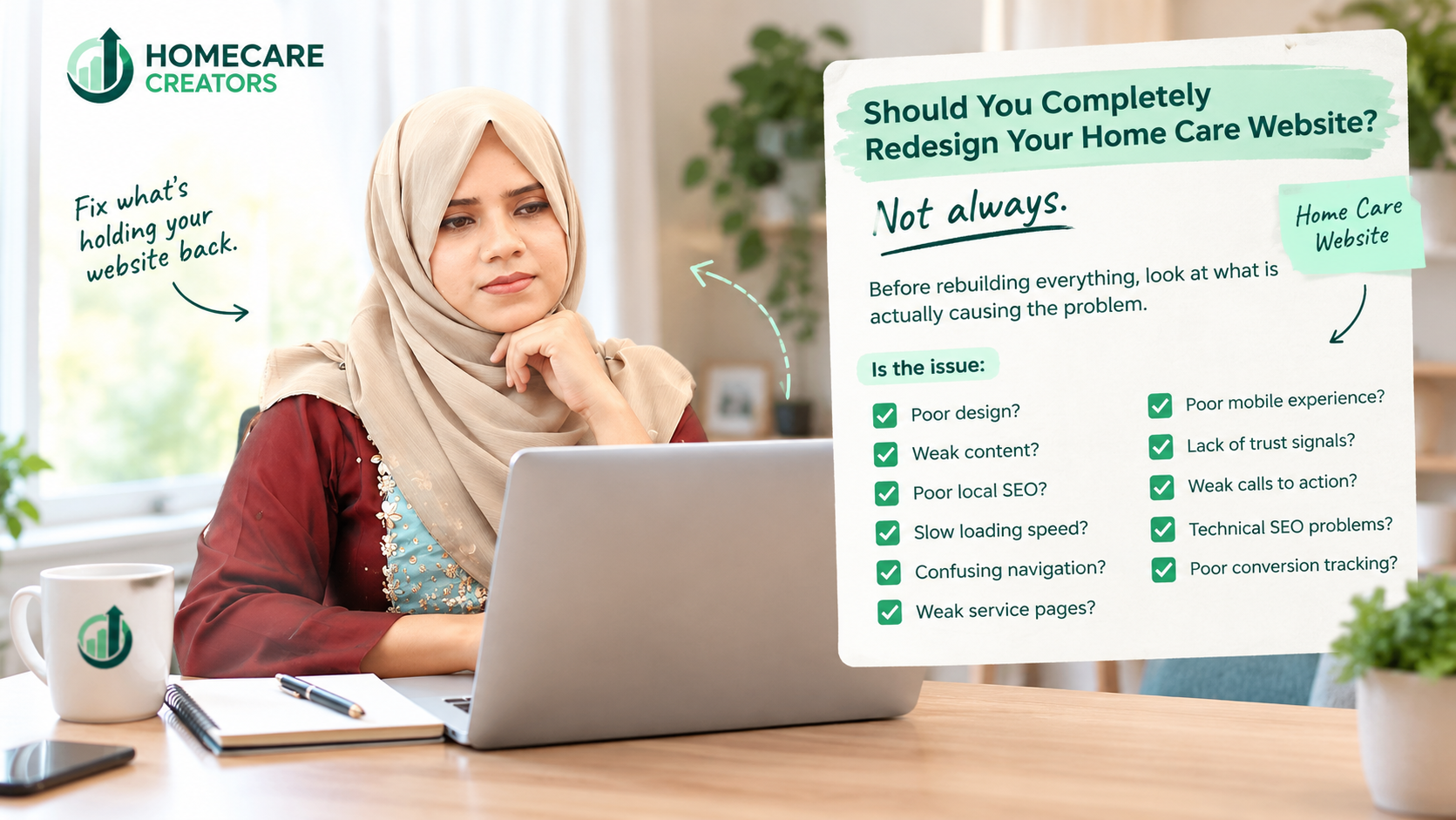
What If Your Home Care Marketing Isn't Working?
Before spending more money, identify where the problem actually exists.
| What you're seeing | What may be wrong |
|---|---|
| Very little website traffic | Visibility problem |
| Traffic but almost no inquiries | Conversion problem |
| Lots of inquiries but few consultations | Intake/follow-up problem |
| Many consultations but few clients | Trust or sales problem |
| Almost all clients come from referrals | Acquisition diversification problem |
| Google Maps visibility is weak | Local SEO problem |
| Visitors leave quickly | Website/message problem |
This simple diagnosis can prevent you from spending money on the wrong solution.
For example, if your website already receives qualified organic traffic but barely generates calls, publishing another 50 blog posts probably isn't the first thing I'd recommend.
I'd look at the website.
What Should a Home Care Agency Do First?
If you're starting from scratch, don't try to fix everything simultaneously.
First 30 Days: Fix the Foundation
Focus on:
- Website messaging
- Mobile experience
- Google Business Profile
- Contact information
- Calls-to-action
- Analytics
- Search Console
- Review process
Days 31–60: Build Search Visibility
Focus on:
- Important service pages
- Priority location pages
- Local SEO
- Internal linking
- High-intent content
- Google Business Profile improvements
Days 61–90: Improve Conversion
Focus on:
- Lead response
- Follow-up
- Consultation process
- Conversion tracking
- Referral relationships
- Google Ads if appropriate
Then review the numbers.
Don't ask only:
“Did our traffic increase?”
Ask:
“Did we generate more qualified conversations and new clients?”
How to Measure Home Care Marketing ROI
Rankings are useful.
Traffic is useful.
But neither pays the bills.
The numbers that matter most are further down the funnel:
Organic traffic
↓
Calls and forms
↓
Qualified leads
↓
Consultations
↓
New clients
↓
Revenue
If you can connect your marketing channels to actual clients, you can make much better decisions about where to invest.
For example, if SEO produces fewer inquiries than paid advertising but significantly more new clients, SEO may actually be the stronger channel.
That's why marketing should be measured against business outcomes—not vanity metrics.
What About AI Search in 2026?
Search is changing.
People increasingly use AI-powered tools to research questions, compare options, and discover businesses.
But that doesn't mean home care agencies should publish hundreds of AI-generated articles.
The better strategy is simpler:
Create information that deserves to be trusted.
Make your content:
- Useful
- Accurate
- Clear
- Specific
- Original
- Written for real people
- Supported by credible sources where appropriate
If your website genuinely answers the questions families have, you're building a stronger digital presence regardless of whether someone finds that information through traditional search or an AI-powered search experience.
Don't create content for machines.
Create content that machines can confidently understand because it is genuinely useful to people.
The Biggest Home Care Marketing Mistakes
1. Focusing only on rankings
A #1 ranking that produces no qualified inquiries isn't a successful marketing campaign.
2. Publishing random blog posts
More content isn't automatically better.
Create content around real questions and real search intent.
3. Having one generic services page
Important services deserve useful, focused explanations.
4. Ignoring Google Business Profile
For local agencies, your presence in Google Maps deserves serious attention.
5. Making visitors hunt for your phone number
If someone wants to call, make calling easy.
6. Buying fake reviews
It isn't worth risking your reputation.
7. Measuring only traffic
Traffic is the beginning of the funnel—not the end.
8. Ignoring follow-up
A lead that never receives a response isn't really a marketing success.
A Better Way to Think About Home Care Marketing
The goal isn't:
“Get more traffic.”
The goal isn't even:
“Get more leads.”
The real goal is:
Create a reliable system that helps more families discover your agency, trust your team, contact you, and ultimately choose your care.
That changes how you approach every marketing decision.
You don't ask:
“Should we write another blog?”
You ask:
“What question are families asking that we can answer better than our competitors?”
You don't ask:
“Should we run Google Ads?”
You ask:
“Can we turn the traffic into qualified consultations profitably?”
You don't ask:
“How do we get more reviews?”
You ask:
“Are we consistently delivering an experience families genuinely want to recommend?”
That's the difference between doing marketing and building a client acquisition system.
How HomeCare Creators Helps Home Care Agencies Grow
At HomeCare Creators, we don't believe home care marketing should be a collection of disconnected services.
SEO shouldn't operate separately from your website.
Your website shouldn't operate separately from your Google Business Profile.
Lead generation shouldn't operate separately from your follow-up process.
They should work together.
Our approach can include:
Home Care SEO
Build organic visibility around the searches that matter to your agency.
Local SEO
Strengthen your visibility in Google Search and Maps.
Home Care Website Design
Turn visitors into calls and consultation requests.
Content Marketing
Create useful resources that answer the questions families are already asking.
AI Search SEO
Strengthen your digital presence as search continues to evolve.
Marketing Automation
Help your team manage and respond to inquiries more consistently.
The objective isn't simply to send more people to your website.
It's to create more opportunities for your agency to have meaningful conversations with families who need care.
Want to Know Where Your Agency Is Losing Potential Clients?
You don't need another generic SEO report telling you to “publish more content” or “build more backlinks.”
You need to know what's actually happening.
Is your agency visible when families search?
Is your Google Business Profile working?
Are competitors appearing ahead of you?
Are your service pages targeting the right searches?
Does your website build enough trust?
Can families easily contact you?
Are your inquiries turning into consultations?
Are you following up consistently?
At HomeCare Creators, we can review these areas and identify the opportunities that deserve attention first.
Get Your Free Home Care Growth Audit
We'll look at your:
- Website
- Google Business Profile
- Local visibility
- Search performance
- Competitors
- Service pages
- Location pages
- Content
- Conversion opportunities
No generic checklist. No pressure. Just a clear picture of where your agency may be leaving potential clients on the table.
Get Your Free Home Care Growth Audit →
Frequently Asked Questions
How can I get more clients for my home care agency?
Start by making your agency easy to find when families search locally. Then make your website trustworthy and easy to contact. Google Business Profile optimization, local SEO, useful content, reviews, paid search, referral relationships, and consistent lead follow-up can all contribute to growth.
Is SEO worth it for a home care agency?
SEO can be valuable for home care agencies because families often research care options online before contacting a provider. The key is to focus on relevant searches and measure qualified inquiries and new clients—not rankings alone.
How can I get more private-pay home care clients?
Focus on high-intent searches, strong local visibility, useful service pages, genuine reviews, clear website messaging, and a consultation process that makes families feel comfortable taking the next step.
Why is my home care website getting traffic but no leads?
The problem may not be traffic. Your messaging may be unclear, your calls-to-action may be weak, your website may lack trust signals, or visitors may not immediately understand what you offer and how to contact you.
Should I use Google Ads or SEO?
They serve different purposes. Google Ads can help you access existing search demand quickly, while SEO can build organic visibility over time. The right combination depends on your market, competition, budget, and ability to convert inquiries into clients.
How long does home care SEO take?
There is no reliable universal timeline. Results depend on competition, location, website quality, existing authority, content, technical SEO, and implementation. Be cautious of anyone promising guaranteed rankings or a guaranteed number of clients within a specific timeframe.
Final Thought
Home care marketing isn't really about marketing.
It's about being there when a family needs help—and making it easy for them to trust you.
A family may discover you through Google.
They may check your reviews.
They may visit your website.
They may read one of your guides.
They may call your agency.
And then they'll decide whether they feel comfortable putting someone they love in your care.
Every part of your marketing should support that decision.
Get found.
Build trust.
Make the next step easy.
Respond quickly.
Deliver excellent care.
Then let that experience create the reviews, referrals, and reputation that bring the next family to you.
That's what sustainable home care marketing should look like in 2026.
Ready to dominate local search in your Florida market?
Get a free SEO audit — we'll show you exactly where you're losing clients to competitors.